
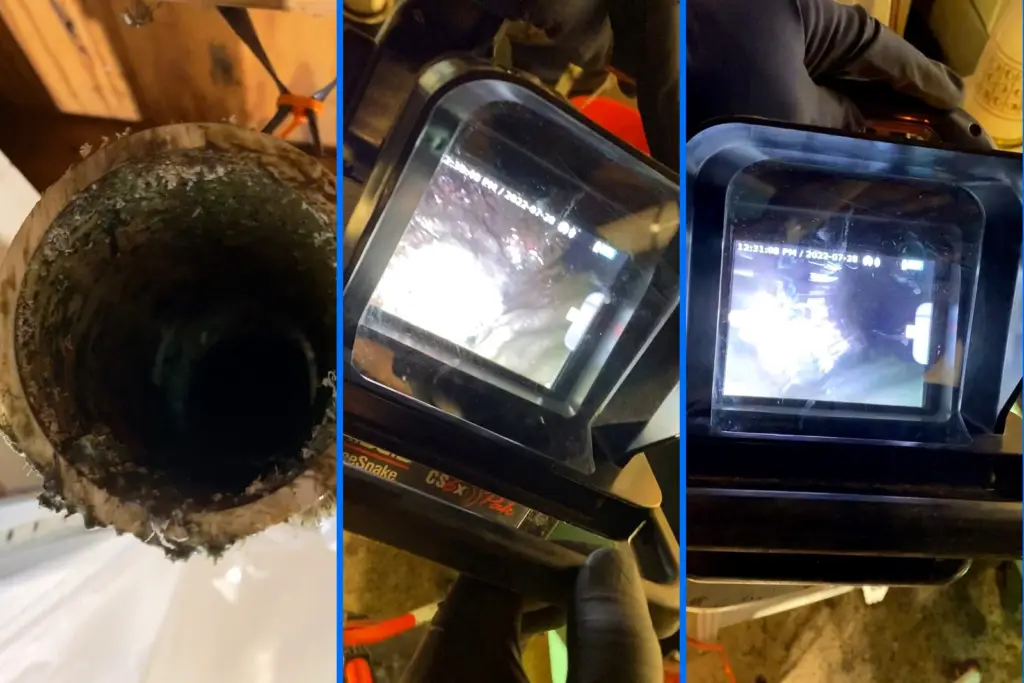
Sewer Camera Inspection in the DC Metro Area
A sewer line runs underground and out of sight, so when something goes wrong down there, most diagnoses are really guesses based on the symptoms up top. In other words, a camera inspection takes the guessing out. We run a waterproof camera through the line and watch exactly what’s happening inside your pipe — so whatever gets decided next is based on what your line actually looks like, not on a hunch.
When a camera inspection makes sense
- Your main line keeps backing up, or the same clog keeps coming back after clearing
- Several drains are acting up together, or you’re hearing gurgling and smelling sewage
- You’ve been told you need a sewer repair or replacement, and you want to see the problem for yourself before you commit to it
- Your home is older and nobody knows the line’s age, material, or condition
- A patch of your yard stays wet or unusually green, or the ground is starting to sink in one spot
Drains backing up right now? Start with Drain Cleaning. Sewage coming into the house? Call us at (301) 971-4884.
What the camera can show us
- Tree roots growing in through the joints
- Cracks, breaks, and corrosion
- Bellies — sections of pipe that sag and hold water and waste
- Offset or separated joints
- Grease and buildup narrowing the pipe
- A collapsed section of line
- What’s actually causing a blockage — and exactly where it sits
How a sewer camera inspection works
- We get into the line. The camera goes in through an accessible cleanout. If your home doesn’t have one we can reach, we can often go in through a toilet instead — either way, there’s no digging just to take a look.
- We run the camera through and watch it live. You’ll see what we see, on the screen, as it travels the line.
- We pinpoint the problem. Where it is and how deep — so if a repair is needed, it targets the bad spot instead of the whole line.
- You get the straight story. What’s healthy, what isn’t, what needs attention now, and what can safely wait. No pressure either way.
See it before you spend on it
A sewer repair is a big decision, and most of it happens underground — where you can’t check the diagnosis or the work yourself. A camera inspection turns “trust us, it’s bad” into “look — there it is.” If your line is fine, you’ll know that too, and you’ll have ruled out the expensive possibilities before paying for any of them. And if there is real damage, you’ll know exactly where it is and how much of the line it involves — one bad section is a very different job from a whole new line.
Sewer camera questions we hear
How long does a camera inspection take?
In short, most inspections are done within a single visit — the length of the line and what we find set the pace. We’ll talk you through what we’re seeing as we go.
Do you have to dig to inspect the line?
No — instead, the camera enters through an accessible cleanout — or through a toilet, if your home doesn’t have a cleanout we can reach. Digging only enters the picture if a repair is needed and you’ve decided to go ahead with one.
Can you tell exactly where the problem is?
Yes — that’s the point of the camera. We can pinpoint the spot and the depth, which is what keeps a repair focused on the section that’s actually bad.
What if the camera finds nothing wrong?
Then that’s your answer — the problem is most likely a blockage that drain cleaning can handle, and you’ve ruled out the big-ticket possibilities with proof instead of a guess.
Do you do camera inspections after hours or on weekends?
Our hours are Monday to Friday, 8 to 5. If you’re reading this after hours with sewage backing up, shut the water off if you can do it safely and leave us a message — we check messages after hours too, and we’ll get back to you as soon as we can.
Licensed & Insured · WSSC License #P 74018 · Rated 5.0 ★ on Google · 2-Year Parts & Labor Warranty
Stop guessing about your sewer line. Call (301) 971-4884 — Monday to Friday, 8 to 5. Tell us what the line’s been doing, and we’ll take it from there.